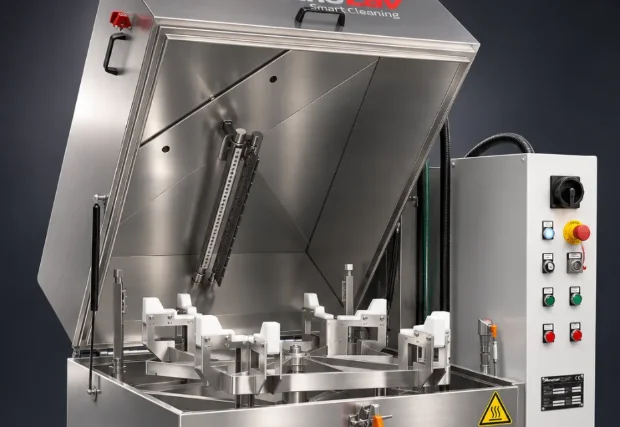
ECO cleaning machine in the industrial sector
An industrial company needs to clean steel molds after they have been sandblasted. Sandblasting leaves residue behind: at the end, no visible carbonate must remain and the mold must be completely dry. Project data: two references (690 × 690 mm and 790 × 790 mm, 8 to 55 mm thick, up to 269 kg), a cycle of under 8 minutes excluding handling, and raw water with no chemicals. The heavy molds are placed in the machine with a forklift.
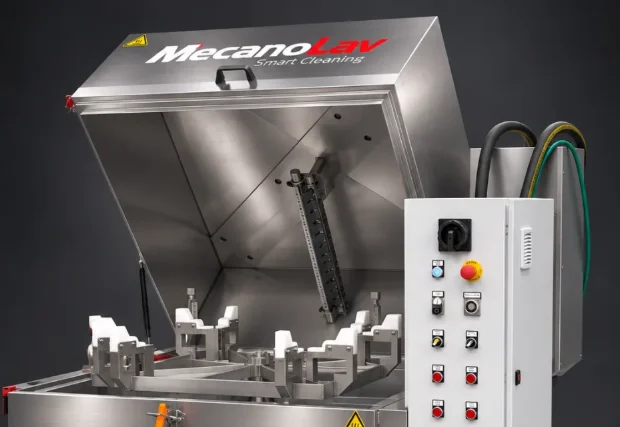
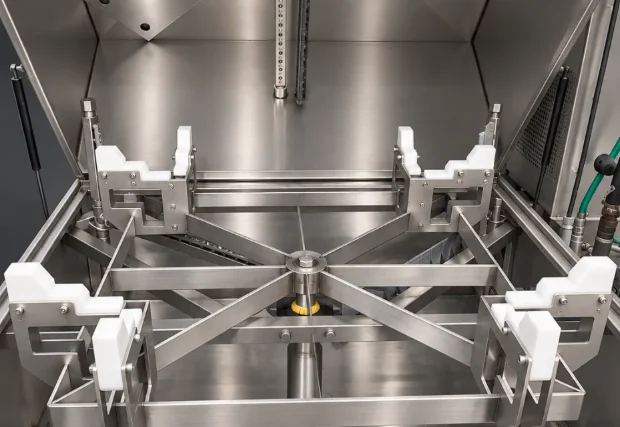
The mold sits on a rotating plate designed for gentle placement by forklift. Around it, three U-shaped spray ramps (above, below and at the sides) spray water onto the mold from three directions, in a closed circuit, with a 4-bar stainless steel pump. The tank is heated and fills automatically. The plate is driven by a direct shaft; a variable frequency drive sets the rotation speed, and the plate automatically returns to its start position at the end of the cycle.
For drying, a compressed-air blowing ramp with flat jets, built into the lid, blows out the water left in blind holes and threads. The lid stays locked until the cycle is finished (electromagnetic lock). An air/air vapor condenser limits the steam released into the workshop: no roof connection is needed. A retention tray with fork pockets lets you move the machine by forklift, and a leak detector shuts off the water if needed. The IC4, the largest model of the ECO range, is controlled by a Siemens S7-1212 PLC.