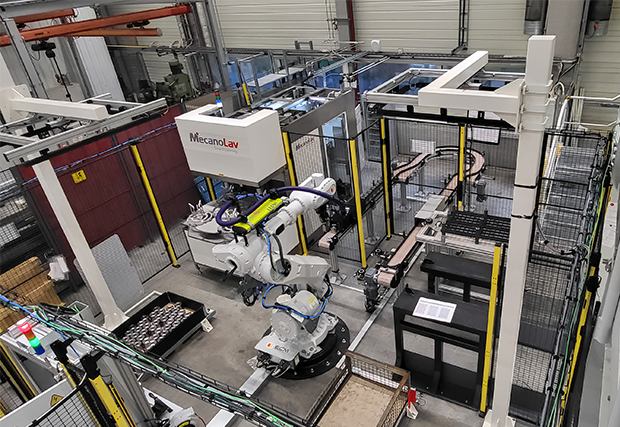
In an automated production line, parts cleaning should not become an isolated step or slow down the production flow. The cleaning machine must be directly integrated between the different manufacturing operations, such as machining, inspection, assembly, heat treatment, etc.
At MecanoLav, our cleaning machines can be designed to operate with fully automated robotic loading and unloading. Depending on the application, we adapt our MecanoFAST and MecanoHAX solutions, or develop machines specifically tailored to the customer’s production environment.
The cleaning machine, the robot and its peripheral equipment together form a complete robotic cell, designed as an autonomous unit fully integrated into the production line.
MecanoFAST Integration
L’objectif : garantir la qualité du nettoyage tout en respectant la cadence, l’espace disponible et The objective is to guarantee cleaning quality while meeting the required production rate, available space and overall line organization.
A Machine Designed to Match the Production Line Pace
Integrating a robotic cleaning machine starts with an analysis of the production flow:
- required production rate;
- available cycle time;
- number of part references to be processed;
- operations carried out before and after cleaning;
- part infeed and outfeed method;
- available floor space in the workshop.
The machine must be able to keep pace with the production line without creating a build-up of parts upstream or downstream.
For high-throughput applications, one-piece-at-a-time processing allows the cleaning stage to be integrated directly into the production flow. A part can leave a machining center, be picked up by a robot, cleaned and dried, and then immediately transferred to the next operation.
Part Fixtures Specifically Designed for Robotic Handling
The part fixture is a key element of robotic integration. It must allow the robot to place and retrieve the part easily, while ensuring precise and repeatable positioning.
This repeatability is essential: it ensures that, during every cycle, the part is placed and picked up in exactly the same position by the robot gripper, with no variation.
This consistency is what guarantees uniform cleaning quality from one part to another, cycle after cycle.
Our fixtures are custom-designed to match the geometry of each part.
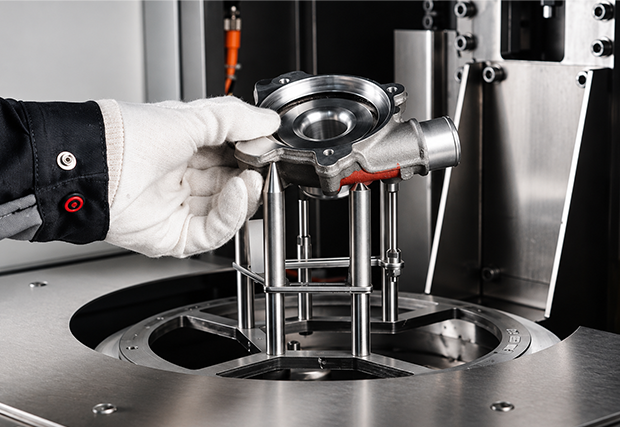
Custom-Designed Fixture
They must also keep the areas to be cleaned accessible and promote proper liquid drainage in order to prevent fluid retention.
Depending on the configuration, the robot can load the parts from the front or directly from above. The robot gripper and its geometry are also defined according to the part, in order to ensure reliable and repeatable handling during every cycle.
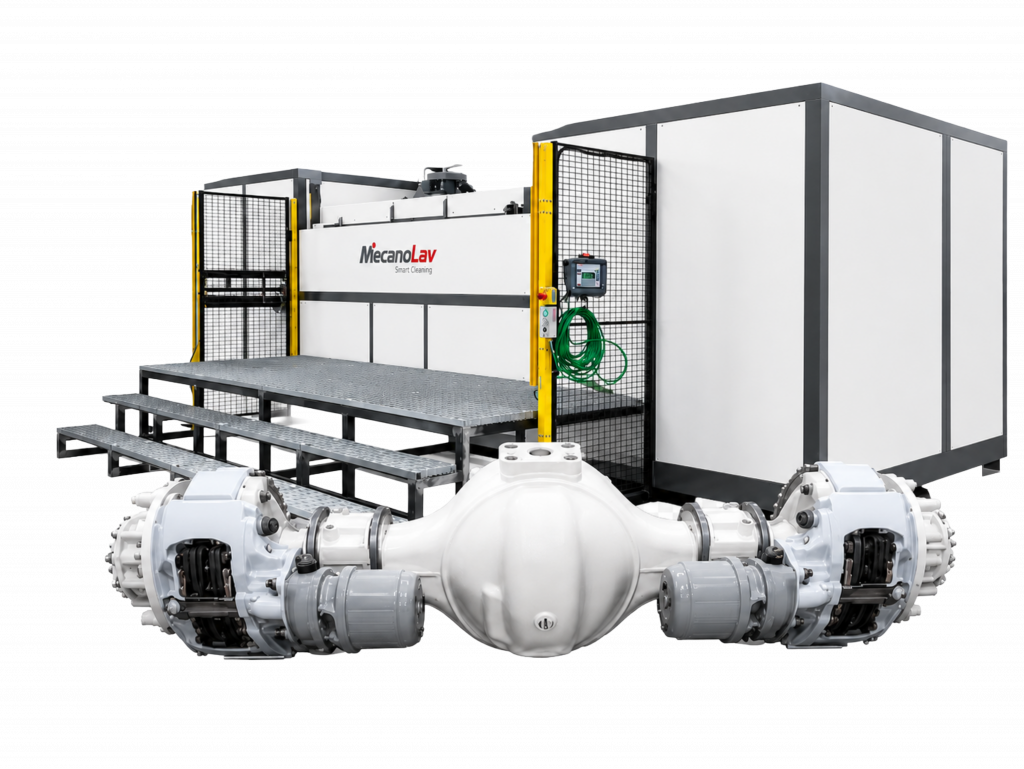
This solution is particularly well suited to long, tubular or difficult-to-handle parts. On the MecanoHAX, for example, the top opening makes robotic loading easier for components such as tubes, cylinder bodies or long parts, thanks to its automatically opening lid.
Loading and Unloading During Machine Cycle
To maintain a high production rate, loading and unloading can be carried out while the machine is cleaning another part.
On a machine equipped with a rotary table, several operations can take place simultaneously:
- one part is being washed and dried;
- a clean part is picked up by the robot;
- a new dirty part is loaded.
In certain configurations, the robot can even perform two operations in a single movement: it unloads the clean part and loads the next dirty part in the same pass, without any intermediate repositioning.
This combined action further reduces cycle time and improves overall process flow.
MecanoFAST with 2-Position Rotary Table
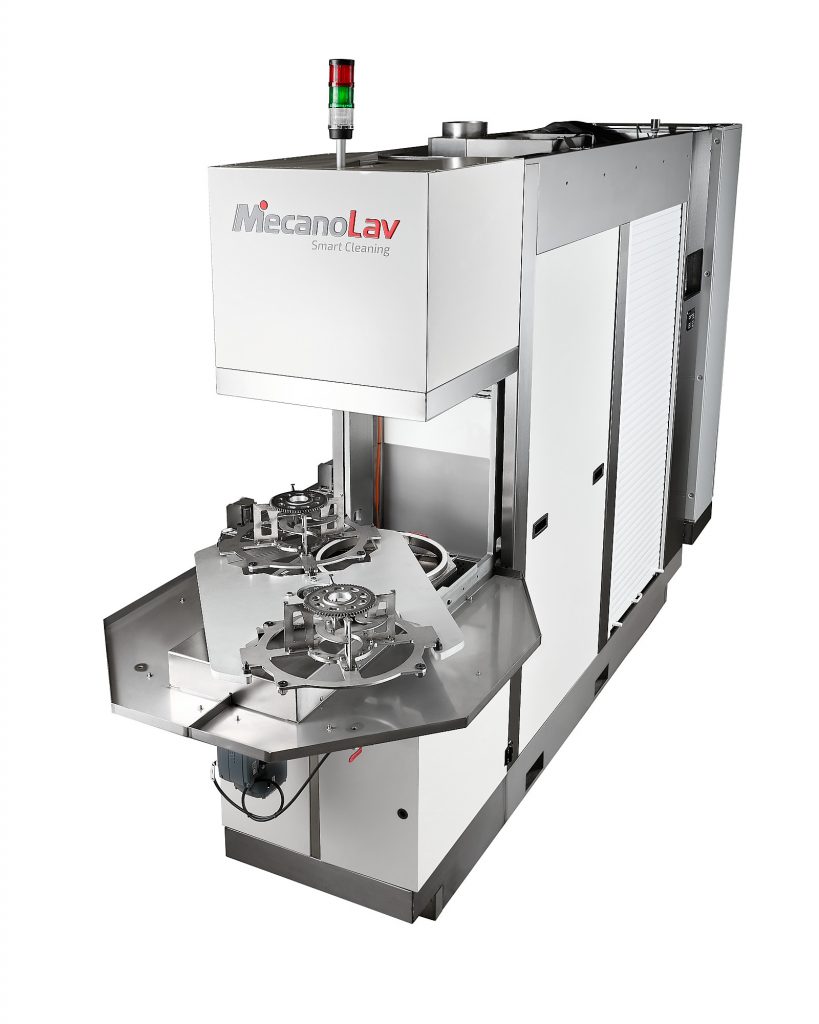
The time required for part handling therefore does not add to the cleaning cycle time. This is known as loading and unloading during machine cycle.
This approach reduces idle time, maintains a steady production flow, and optimizes the use of both the robot and the cleaning machine.
Seamless Integration into the Production Line
When integrated directly into an automated production line, the cleaning machine becomes a fully integrated part of the manufacturing process. It helps reduce intermediate work-in-progress, handling operations and waiting times, while improving part traceability.
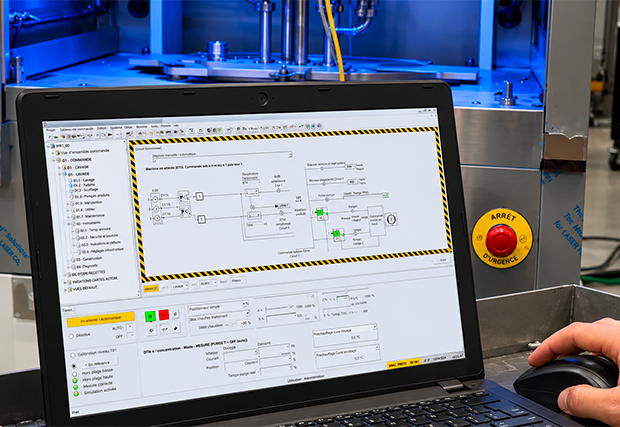
To ensure smooth and safe operation, the machine continuously communicates with the robot and the line PLC: station availability, part presence, cycle start and completion, authorization for part removal, and fault reporting.
These interfaces are defined from the very beginning of the project together with the system integrator and the customer’s engineering teams.
A Layout Adapted to Every Industrial Environment
Robotic integration is not limited to the dimensions of the cleaning machine itself. The study also takes into account the robot’s operating range, conveyors, safety systems, electrical cabinets, traffic areas and the access required for maintenance.
These systems define and secure the robotic cell: safety light curtains detect any intrusion into the robot’s working area and stop movement when necessary; access gates provide controlled entry for maintenance; and protective guarding physically encloses the cell to protect operators from splashes and robot movement.
Each solution is therefore designed according to the parts to be processed, their geometry, the required production rate, the target cleanliness level and the available space.
MecanoLav works closely with the customer and the system integrator to define the cleaning machine, part fixtures, washing and drying process, loading method and the complete layout of the robotic cell.